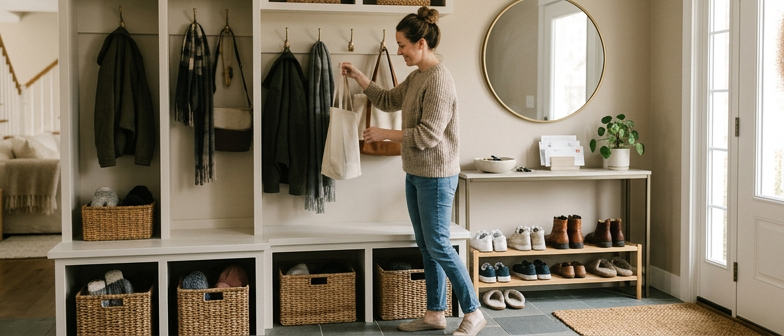
Why Entryway Organization Matters
A well-organized entryway acts as a buffer between the outside world and the rest of the home, which can make daily routines feel calmer and more predictable. When there is a clear place to drop bags, keys, shoes, and mail, it becomes easier to get out the door on time, find what you need, and reduce last-minute stress. Centralizing these essentials in one small area also limits how much dirt, moisture, and clutter spread into living spaces, which can help protect flooring and surfaces and make regular cleaning more manageable.
Consistent entryway storage habits also contribute to safety and long-term home maintenance. Designated spots for shoes, coats, and gear reduce tripping hazards around the doorway, especially in compact layouts where space is tight. A simple daily entryway reset, such as hanging up outerwear, returning shoes to a rack, and clearing the floor, can prevent clutter from building up over the week. While organization cannot remove every source of mess or delay, even small, repeatable routines in this high-traffic zone can support smoother mornings, easier evenings, and a more functional home overall.
Planning a Small Entryway Layout
Start by watching how people actually move through the entry. Notice where shoes, bags, and mail usually land, and how doors open, including any closet doors that might block the path. Measure the hallway or nook and the distance from the door to nearby walls so you know how much floor and wall space can be used without creating a tripping hazard. Check for outlets, heaters, or vents so storage pieces do not block airflow or make cleaning difficult.
With the dimensions and traffic patterns in mind, decide which tasks the entry must handle every day. Many households need a place to remove shoes, hang coats, and drop keys or a bag. In a compact layout, this often means choosing slim, multiuse pieces, such as a narrow console with shelves or a wall-mounted rail with hooks and a small shelf above. Keeping furniture to a minimum and placing it along the walls helps preserve a clear walkway while still providing useful storage.
Use vertical and concealed storage to keep the space calm and easy to reset. Wall hooks, shallow shelves, or a slim cabinet can hold coats and accessories without taking up much depth, while baskets under a bench or labeled bins in a nearby closet can contain shoes and small items. It is rarely practical to store everything at the door, so prioritize daily essentials and place off-season or rarely used pieces elsewhere. This balance supports a quick daily tidy and keeps a small entryway functional.
| Entryway Scenario | Layout Focus | Recommended Storage | Traffic Flow Impact |
|---|---|---|---|
| Narrow hallway | Keep walls clear and depth minimal | Wall hooks and slim rail | High, maintains single clear path |
| Open-plan entry | Define a subtle landing zone | Narrow console with shelves | Medium, relies on visual boundaries |
| Entry with stairs nearby | Avoid blocking stair access | Low bench with baskets | High, separates sitting and walking zones |
| Small nook off main room | Maximize vertical reach | Shallow cabinet and upper hooks | Medium, may narrow turning space |
| Door opening directly to living area | Protect main walkway | Compact shoe tray and small hook strip | High, keeps clutter at door edge |
Zoning Your Entry for Real-Life Routines
In a small entryway, start by tracing your path from the door to the main living area and giving each stop a clear job. Just inside the door, use a narrow mat or tray as a landing area for shoes that fits the available width. A few steps in, mount hooks or a slim rack for everyday coats and bags at a height everyone can reach. Near the light switch, add a compact spot for keys, wallets, and mail with a shallow shelf or narrow console that still lets doors open fully. To keep these zones working, build in a brief daily reset, spending a few minutes returning shoes to the tray, rehanging coats, and clearing junk mail so clutter does not build up.
Practical Shoe Storage Solutions
Choosing how to store shoes near the door starts with counting how many pairs are used in a typical week and how much floor space a small entryway can spare. Even a few loose pairs can feel messy, so it helps to set a clear limit for how many stay by the door and keep the rest in a closet or bedroom. Shallow cabinets, slim shelving, or a compact rack under a console can hold everyday pairs without blocking movement, as long as there is space for the door to open fully and for people to stand and put on shoes.
Open storage, such as low racks, trays, and baskets, suits households that are constantly coming and going because shoes stay visible and easy to grab. A simple rack lines up several pairs without stacking, while a lipped tray or mat catches dirt and water in wet or snowy weather. The trade-off is more visual clutter, so this setup works best for people who are comfortable with a casual look or who tidy the area regularly. For homes with pets or young children, slightly higher shelves or heavier baskets can cut down on tripping and tipping.
Closed storage, including cabinets with doors or pull-out compartments, hides shoes completely and can make a small entryway feel calmer and more finished. These pieces suit smaller households or anyone who rotates shoes seasonally, because once the interior is full it is hard to squeeze in extra pairs. Ventilation and easy-to-clean surfaces matter, since enclosed spaces can trap moisture or odor when wet shoes are stored. Many entryways work best with a mix, such as closed storage for off-season pairs and a small open rack or bin for the few shoes worn every day.
Managing Everyday and Seasonal Shoes
To keep entryway organization manageable, divide shoes into two groups: pairs worn most days and pairs used only occasionally or by season. Place everyday footwear on the most accessible shelves, in shallow bins, or under an entry bench so they are easy to grab without piling up on the floor. Move dress shoes, hiking boots, or off-season sandals into labeled boxes, clear bins, or a secondary closet so only a few pairs per person stay by the door. Maintain this setup with a brief weekly reset, returning anything not worn that week to long-term storage and swapping in what you expect to need soon, such as rain boots before wet weather.
Coat Storage Ideas and Bench-Based Organization
Planning coat storage starts with the wall space and traffic in your entryway. In a wider area, a sturdy row of hooks or a shallow rail keeps everyday coats at eye level and lighter layers above. Narrow hallways benefit from a single hook strip, an over-the-door rack, or a slim coat tree that does not block movement. To avoid crowding, keep only current-season coats by the door and move off-season pieces to another closet.
Bags, hats, and small accessories often create more mess than outerwear, so give them specific homes. Lower hooks or the inside of a narrow cabinet can hold backpacks and daily totes, while a small tray or bowl near the door collects keys, passes, and coins. In shared homes, assigning labeled hooks or sections to each person makes it easier to return items quickly. A narrow shelf or cubby above or beside the coat area can hold sunglasses, mail, and leashes, as long as you clear it regularly so it does not become a permanent dumping spot.
An entryway bench adds both seating and compact storage when matched to your layout. A bench with open cubbies keeps shoes and baskets visible, while designs with a lift-up seat or drawers hide clutter but need space to open. To keep this zone orderly, give each person a basket or bin for hats and gloves, and use a shallow tray or mat under the bench to catch dirt from shoes. In very small entries, a narrow bench with a single shelf or a wall-mounted perch paired with a separate low shoe rack offers a place to sit without blocking the door.
Q&A
-
How do I arrange a tiny entryway so people don’t trip?
Measure the space, note door swing, then choose shallow pieces like wall hooks, a slim shoe rack, or a narrow shelf. Keep the walking path clear and avoid deep furniture near the door. -
What works for storing many pairs of shoes near the door?
Decide a realistic limit for pairs that stay by the entrance. Use shallow cabinets, stacked racks, or labeled bins for those, and keep the rest in another closet, rotating by season. -
How can I separate everyday shoes from rarely used ones?
Put daily pairs on the lowest, most reachable shelf or under a bench. Move dress shoes and off-season pairs to labeled boxes or another closet, and review once a week. -
What coat storage options suit a narrow hallway?
Install a single row of hooks, an over-the-door rack, or a slim stand. Keep only current-season layers there and move bulky coats to another area to reduce crowding. -
How can I keep a daily reset routine for the entry?
Pick a fixed time, such as after dinner, and spend a few minutes hanging coats, returning shoes, and tossing junk mail so the space is reset each day.